 Watching Itself Watch: Self-Auditing Visual Reliance for Video Reasoning
Rohan Dugad, Mi Luo, Kristen Grauman
 The University of Texas at Austin
NeurIPS 2026
Watching Itself Watch: Self-Auditing Visual Reliance for Video ReasoningRohan Dugad, Mi Luo, Kristen Grauman
The University of Texas at Austin
NeurIPS 2026
TL;DR: Video reasoning hinges on a few visually decisive tokens, yet post-training rewards whole trajectories. VIOS lets a model audit its own visual reliance and improves all three backbones across 12 benchmarks, in over 9× fewer steps and 60× fewer FLOPs.
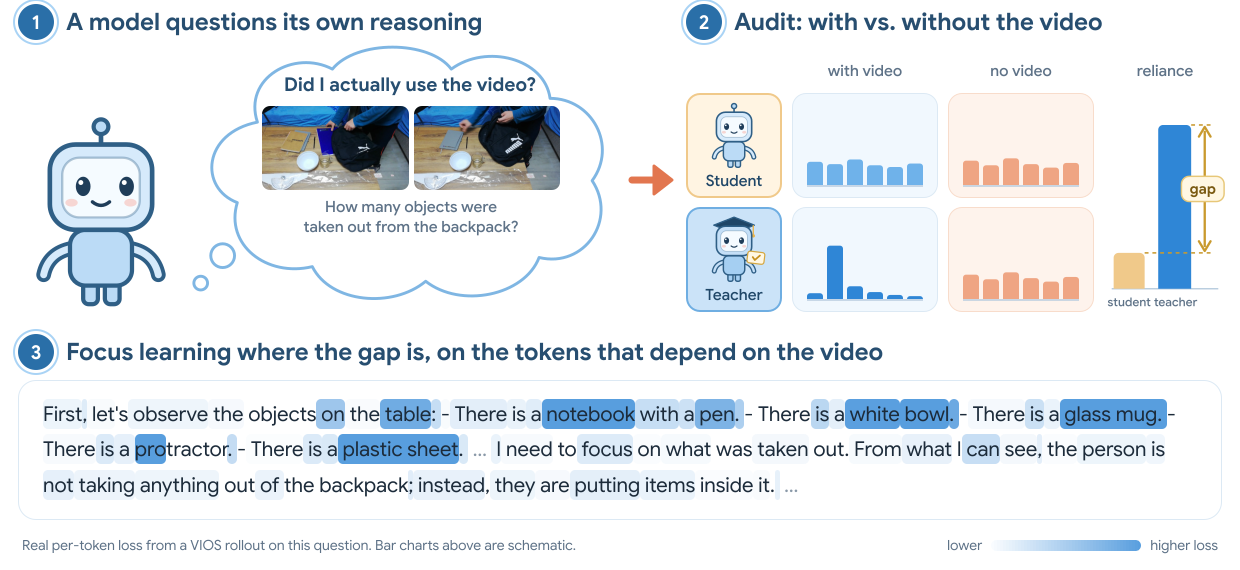
Video reasoning hinges on a small number of visually decisive tokens embedded in otherwise largely language-driven chains of thought. A model can only get these tokens right by paying careful attention to the video.
Prevailing post-training overlooks this structure, and pays a high price for the coarse signal it gets.
Visually-Aware On-Policy Self-Distillation starts from one observation: a model can audit its own visual reliance. Comparing its next-token distribution with and without the video shows how much each prediction depends on what it saw.
Doing this for a student and an answer-privileged teacher exposes a per-token reliance gap: the positions where the visual input is under-utilized.
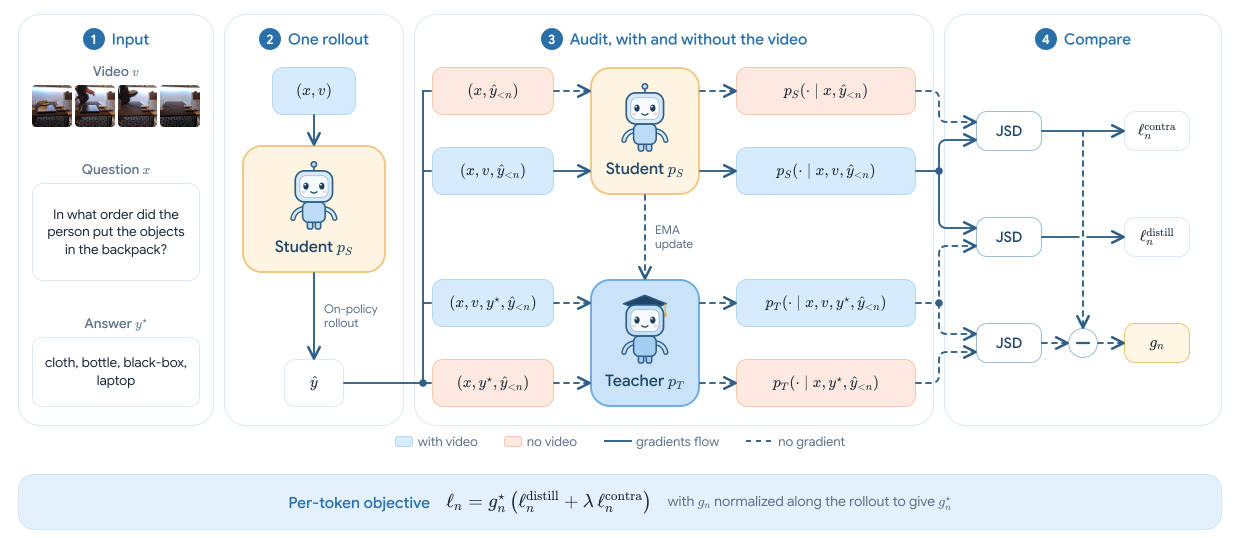
All of this comes from a single on-policy rollout of a single model, with no external rewards, judges, or larger teachers.
| General | Knowledge | ||||||
|---|---|---|---|---|---|---|---|
| Model | MVBench | Video-MME | MINERVA | MMVU | Video-MMMU | VideoMathQA | SciVideoBench |
| Video-R1 | 64.42 | 58.37 | 30.76 | 63.04 | 49.22 | 23.57 | 24.50 |
| VideoRFT | 62.25 | 58.26 | 28.26 | 64.96 | 47.44 | 24.76 | 24.10 |
| VideoChat-R1 | 62.40 | 57.07 | 29.47 | 63.68 | 47.67 | 23.33 | 23.30 |
| VideoChat-R1.5 | 62.17 | 56.89 | 28.56 | 63.20 | 49.22 | 25.00 | 23.20 |
| Video-R2 | 62.08 | 56.04 | 27.42 | 64.80 | 48.33 | 20.00 | 25.40 |
| Qwen2.5-VL-SFT | 60.72 | 55.15 | 29.55 | 59.36 | 47.22 | 23.10 | 22.40 |
| + VIOS (Ours) | 65.50 (+4.78) | 59.59 (+4.44) | 31.36 (+1.81) | 65.76 (+6.40) | 47.44 (+0.22) | 25.48 (+2.38) | 24.90 (+2.50) |
| InternVL2.5-4B | 61.27 | 53.19 | 27.12 | 52.96 | 34.89 | 19.52 | 15.90 |
| + VIOS (Ours) | 68.42 (+7.15) | 57.15 (+3.96) | 30.91 (+3.79) | 57.44 (+4.48) | 40.44 (+5.55) | 21.19 (+1.67) | 19.80 (+3.90) |
| InternVL2.5-8B | 62.42 | 57.93 | 30.38 | 56.48 | 43.56 | 19.29 | 17.90 |
| + VIOS (Ours) | 69.95 (+7.53) | 61.52 (+3.59) | 33.18 (+2.80) | 60.96 (+4.48) | 45.89 (+2.33) | 23.81 (+4.52) | 22.50 (+4.60) |
| Temporal | Long Video | Spatial | ||||
|---|---|---|---|---|---|---|
| Model | TempCompass | TVBench | LongVideoBench | MLVU | VSI-Bench | Average |
| Video-R1 | 71.58 | 50.81 | 55.42 | 63.11 | 35.25 | 49.17 |
| VideoRFT | 72.65 | 53.35 | 54.08 | 61.82 | 35.10 | 48.92 |
| VideoChat-R1 | 72.43 | 52.16 | 53.85 | 57.82 | 33.08 | 48.02 |
| VideoChat-R1.5 | 72.28 | 48.40 | 54.82 | 58.05 | 31.95 | 47.81 |
| Video-R2 | 72.64 | 51.68 | 50.19 | 58.00 | 32.56 | 47.43 |
| Qwen2.5-VL-SFT | 67.25 | 49.82 | 52.51 | 55.70 | 33.44 | 46.35 |
| + VIOS (Ours) | 72.77 (+5.52) | 52.24 (+2.42) | 55.87 (+3.36) | 62.74 (+7.04) | 35.73 (+2.29) | 49.95 (+3.60) |
| InternVL2.5-4B | 62.25 | 52.40 | 43.68 | 57.64 | 33.72 | 42.88 |
| + VIOS (Ours) | 68.01 (+5.76) | 57.43 (+5.03) | 51.61 (+7.93) | 63.57 (+5.93) | 34.14 (+0.42) | 47.51 (+4.63) |
| InternVL2.5-8B | 70.12 | 57.11 | 51.16 | 61.96 | 38.04 | 47.20 |
| + VIOS (Ours) | 72.21 (+2.09) | 61.74 (+4.63) | 58.71 (+7.55) | 66.79 (+4.83) | 36.33 (−1.71) | 51.13 (+3.93) |
Table 1. Main results across 12 video understanding benchmarks. Within each backbone, best in bold and second-best underlined. Numbers in parentheses are gains over the base model of that backbone.
VIOS improves the average of all three backbones, by 3.60, 4.63, and 3.93 points. On Qwen2.5-VL it ranks first on 8 benchmarks and second on 3 more.
VIOS matches or exceeds Video-R1's final accuracy within roughly 100 steps, compared with approximately 1000 steps for Video-R1 and GRPO. All three start from the same base model and use Video-R1's per-step training configuration.
Figure 2. Accuracy across training on four representative benchmarks. The shaded band marks the 110 steps VIOS trains for. Stars mark the public Video-R1 checkpoint.
Figure 3. Training cost of VIOS, Video-R1, and GRPO. Ratios compare VIOS with Video-R1. A single on-policy rollout per step cuts total and per-step compute, samples, and token generation.
| General | Knowledge | |||||||
|---|---|---|---|---|---|---|---|---|
| Model | Steps | MVBench | Video-MME | MINERVA | MMVU | Video-MMMU | VideoMathQA | SciVideoBench |
| Video-R1 | 1,000 | 64.42 | 58.37 | 30.76 | 63.04 | 49.22 | 23.57 | 24.50 |
| VIOS† (Ours) | 110 | 64.45 | 58.63 | 31.67 | 65.12 | 46.33 | 23.60 | 25.24 |
| Temporal | Long Video | Spatial | |||||
|---|---|---|---|---|---|---|---|
| Model | Steps | TempCompass | TVBench | LongVideoBench | MLVU | VSI-Bench | Average |
| Video-R1 | 1,000 | 71.58 | 50.81 | 55.42 | 63.11 | 35.25 | 49.17 |
| VIOS† (Ours) | 110 | 73.25 | 52.00 | 54.00 | 61.68 | 37.05 | 49.42 |
Table 2. Under Video-R1's training configuration, VIOS achieves higher average accuracy and outperforms Video-R1 on 9 of 12 benchmarks in over 9× fewer steps. The better result on each benchmark is in bold. †VIOS rerun with Video-R1's per-step configuration.
Reasoning traces from the base model, Qwen2.5-VL-SFT, and its VIOS post-trained counterpart. VIOS tokens are shaded by per-token loss, which concentrates on the few tokens that depend on the video, such as object identities, attributes, and count updates.
@inproceedings{dugad2026vios,
  title={Watching Itself Watch: Self-Auditing Visual Reliance for Video Reasoning},
  author={Dugad, Rohan and Luo, Mi and Grauman, Kristen},
  booktitle={Advances in Neural Information Processing Systems},
  year={2026}
}
Acknowledgements. This research has been supported by computing support on the Vista GPU Cluster through the Center for Generative AI (CGAI) and the Texas Advanced Computing Center (TACC) at the University of Texas at Austin. UT Austin is supported in part by the IFML NSF AI Institute and Lyda Hill Philanthropies. We thank the UT Vision group for their valuable feedback and insightful discussions.