TL;DR: Video agents usually find the right frames, then trust their own notes over the pixels. We call this Visual Evidence Override. VCA lets the agent edit what stays in its visual context, and leads on all 6 video benchmarks we test.
Visual Evidence Override
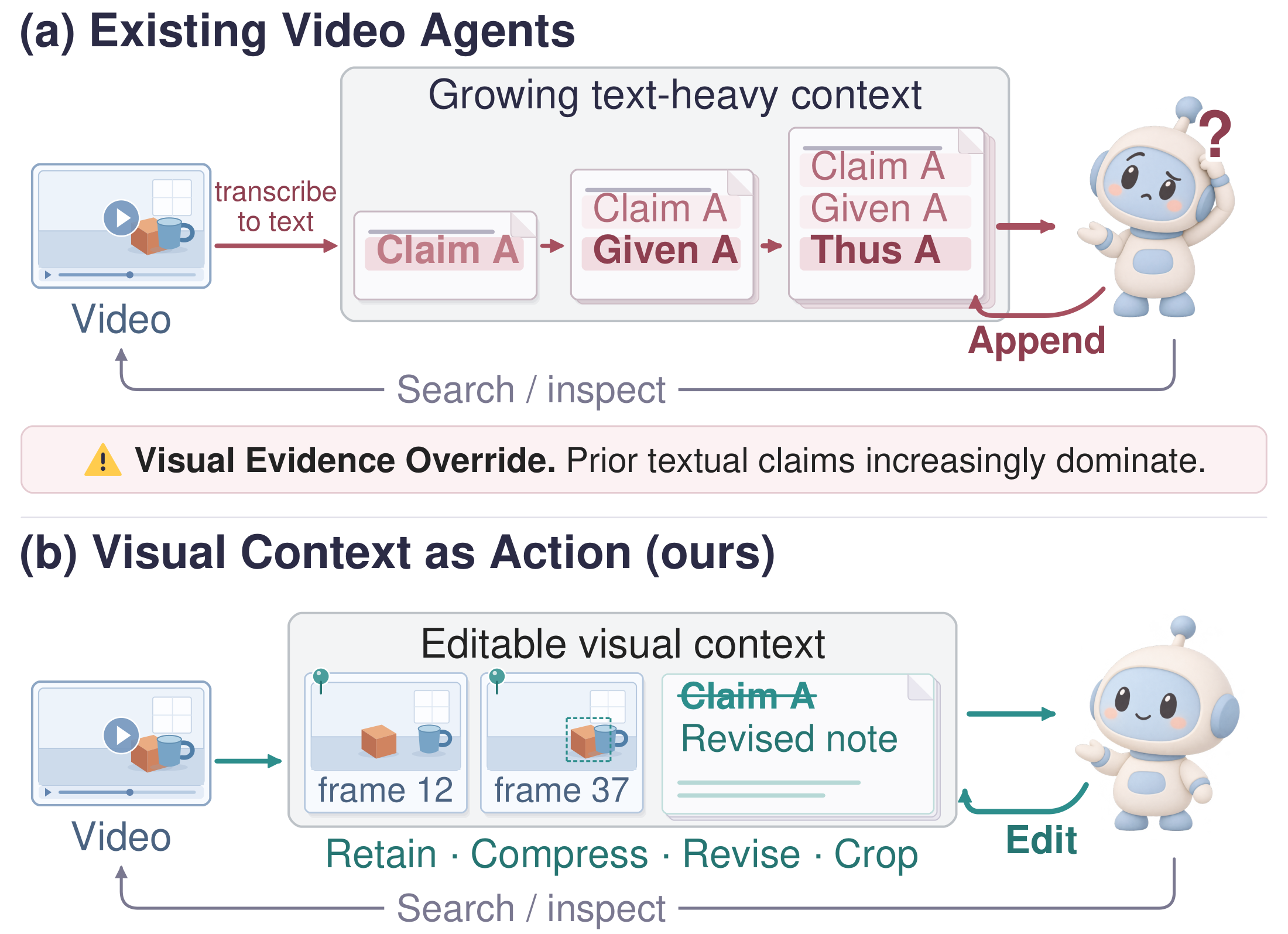
Video agents search a long video, look at frames, and write what they see into text that carries over to the next step. So where do they still go wrong?
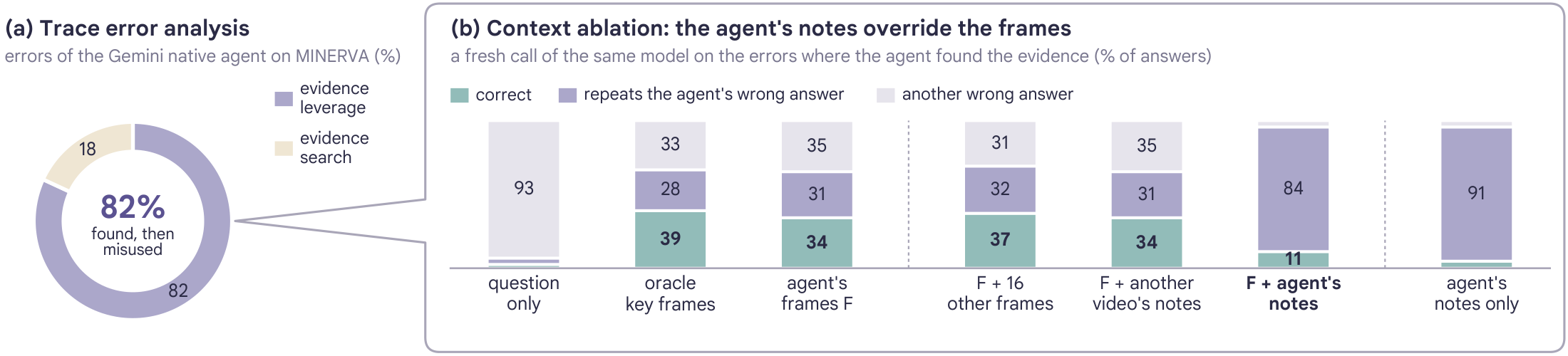
We audit every error of the Gemini native agent on MINERVA. 82% of the errors come after the agent has already found the decisive frames. Only 18% come from failing to find them. Finding the evidence turns out to be the easier half of the job; using it is where agents fail.
(a) Error audit of the Gemini native agent on MINERVA. (b) Re-asking each leverage error in a clean single-turn call, with different context.
34%The frames are enoughA clean call that sees only the agent's own selected frames fixes a third of these errors. The recovery holds with 16 distractor frames (37%) or unrelated notes (34%).
11%The notes override themPut the agent's own notes back in, and recovery collapses to 11%. In 84% of those cases the model repeats its original wrong answer.
Once a claim is written down, it is reused as a premise and slowly outweighs what the frames show. Searching harder cannot fix this. The agent needs control over what stays in view.
VCA: Visual Context as Action
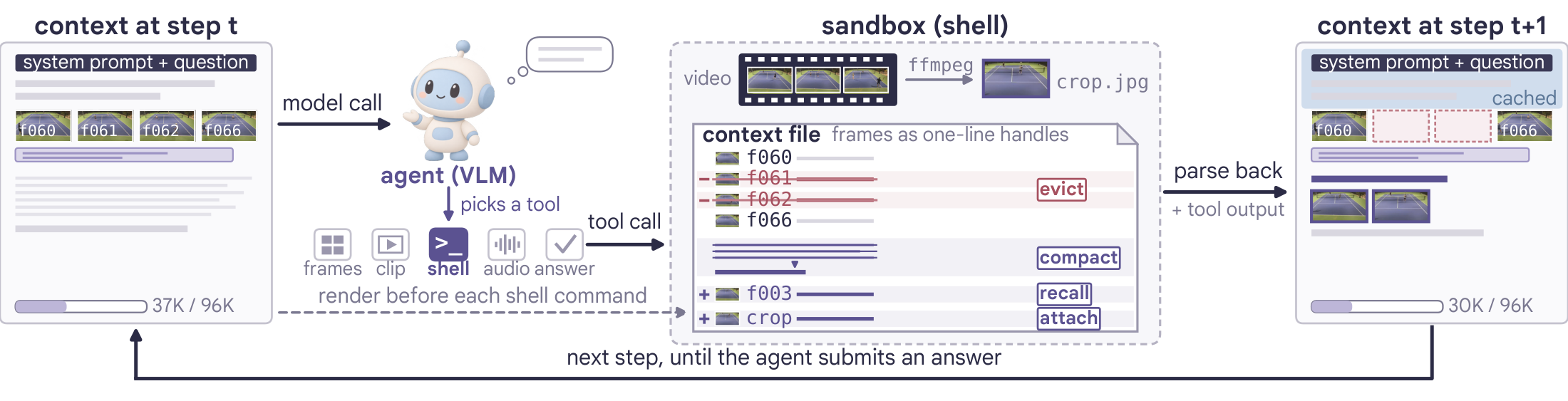
VCA makes editing the context part of the agent's action space. The agent sees frames first-hand in its prompt, and the harness exposes the running context in the sandbox as a plain-text file in which every frame is a one-line handle such as f012. Editing that file with ordinary shell commands changes what the agent sees at the next step.
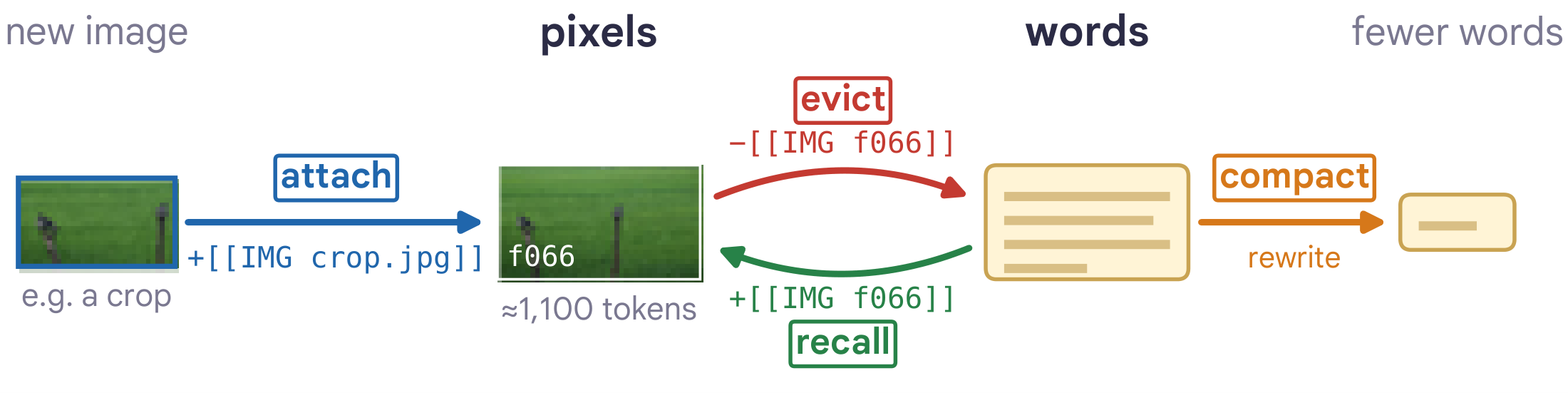
evict Drop a frame's pixels once what matters in it is captured in a note.
recall Bring an evicted frame back when a later sub-question needs it again.
attach Add a new image made in the sandbox, such as a zoomed crop of a scoreboard.
compact Rewrite settled turns into shorter notes, and revise notes that went stale.
Because the agent edits text, it needs no custom action head. When the file is parsed back, every untouched turn is restored byte for byte, so the prompt prefix stays stable and 84% of input tokens are served from cache. Keeping pixels in view becomes cheap.
Results
We evaluate on four long-video benchmarks and two open-world benchmarks that also need web knowledge.
Method
MINERVA
VideoGAIA
LVBench
VideoDR
Video-MME
LongVideoBench
overall
long
val
long
General-purpose MLLMs
GPT-4o
45.5
-
48.9
35.0
71.9
65.3
66.7
60.9
Gemini-2.5-Pro
61.8
-
67.4
-
82.4
77.6
69.8
66.6
Gemini-3.8-Flash*
74.6
52.4
85.7
72.0
90.8
89.0
82.6
82.3
Gemini-4-Argon*
78.3
57.6
87.7
77.0
92.4
90.7
85.2
85.1
Agentic video frameworks
AVP
65.6
-
74.8
-
85.3
81.9
73.4
70.0
VideoARM
-
-
79.7
-
80.1
75.3
73.7
69.2
VideoXAgent
65.7
-
76.5
-
-
85.1†
-
78.1†
VideoLoop
-
-
-
-
-
88.3
-
80.9
Gemini native agent (3.8-Flash)*
78.3
54.6
87.4
76.0
91.7
89.6
85.2
84.6
Gemini native agent (4-Argon)*
83.4
57.9
88.6
78.0
93.2
92.0
86.2
84.8
Ours
VCA w/ Gemini-3.8-Flash
81.8 (+7.2)
55.4 (+3.0)
89.2(+3.5)
84.0(+12.0)
93.0 (+2.2)
91.2 (+2.2)
87.3(+4.7)
87.4(+5.1)
VCA w/ Gemini-4-Argon
87.4(+9.1)
62.0(+4.4)
91.8(+4.1)
90.0(+13.0)
94.7(+2.3)
93.3(+2.7)
89.1(+3.9)
88.3(+3.2)
Table 1. Comparison on six long-horizon and open-world video benchmarks. Best in bold underline, second-best in bold. Numbers in parentheses are gains over direct inference with the same backbone. *Our unified runs. †With subtitles.
VCA with Gemini-4-Argon is best on every benchmark. With the same backbone, VCA beats the Gemini native agent on all eight columns, for both Gemini-3.8-Flash and Gemini-4-Argon.
Same backbone, different harness
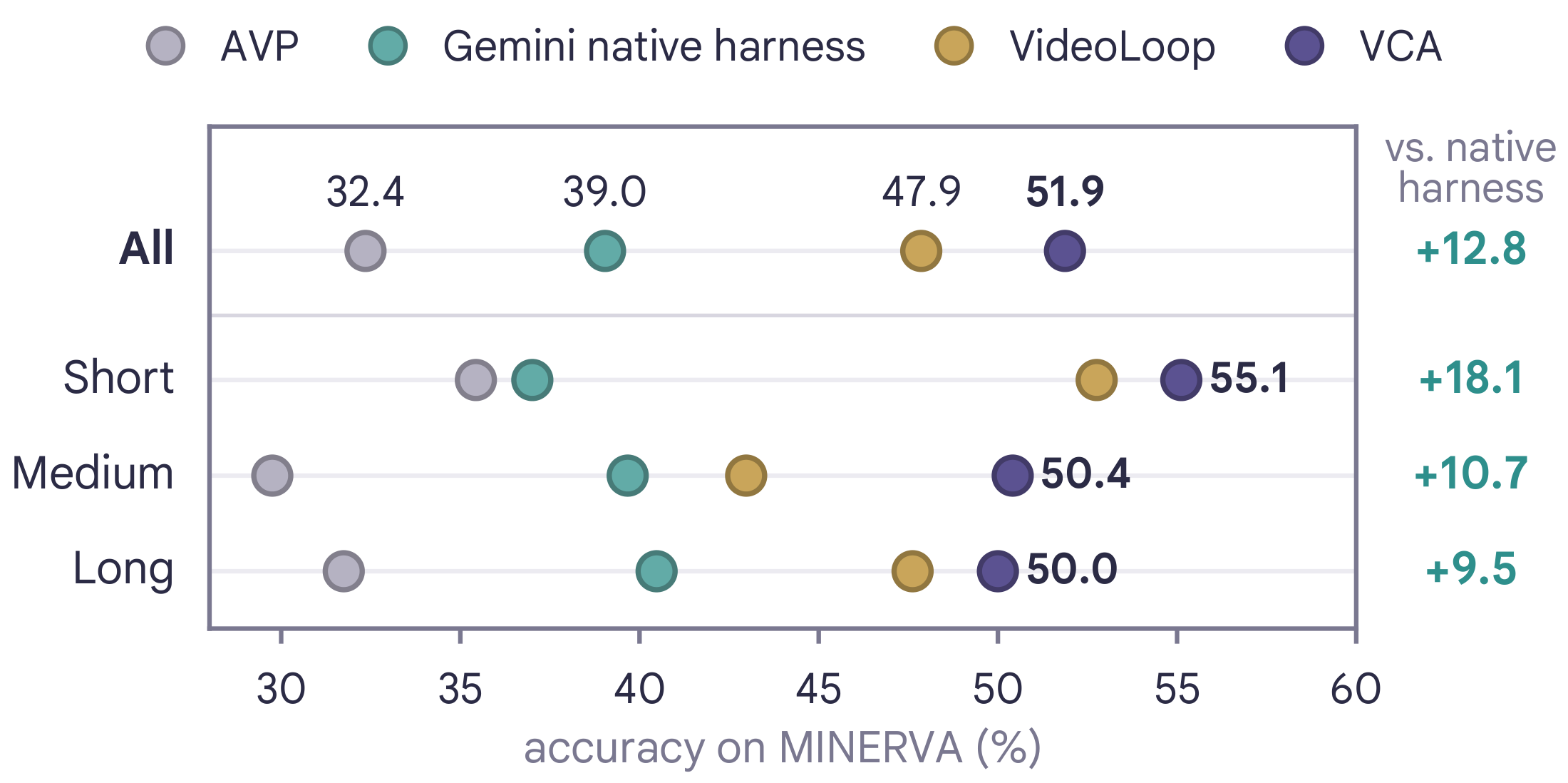
A leaderboard mixes backbones and tools, so it cannot tell how much of a gain comes from the harness. We therefore run four harnesses with the same Gemini-3.8-Flash on the hardest multi-step MINERVA questions, which cannot be answered in a single look. VCA reaches 51.9%, +12.8 points over the native harness, and leads at every video length.
Keeping pixels is cheaper, not costlier
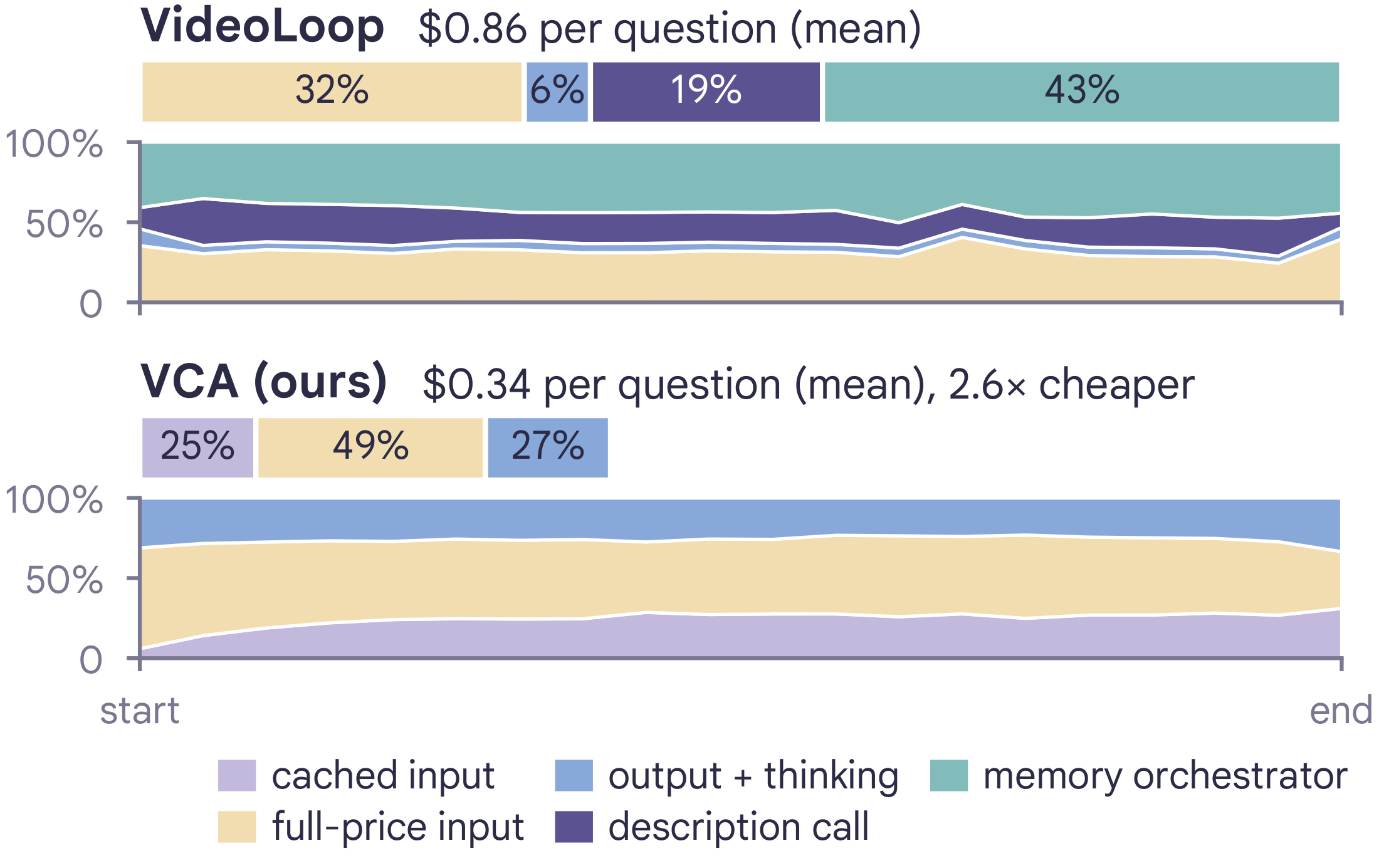
Holding raw frames across many turns sounds expensive. The modular pipeline VideoLoop drops pixels early, yet spends 62% of its budget on separate frame-description and memory calls, and rewriting its memory block keeps cache hits below 1%. VCA needs no extra calls and keeps its prefix stable, so it costs 2.6× less per question.
Self context editing matters most on long videos
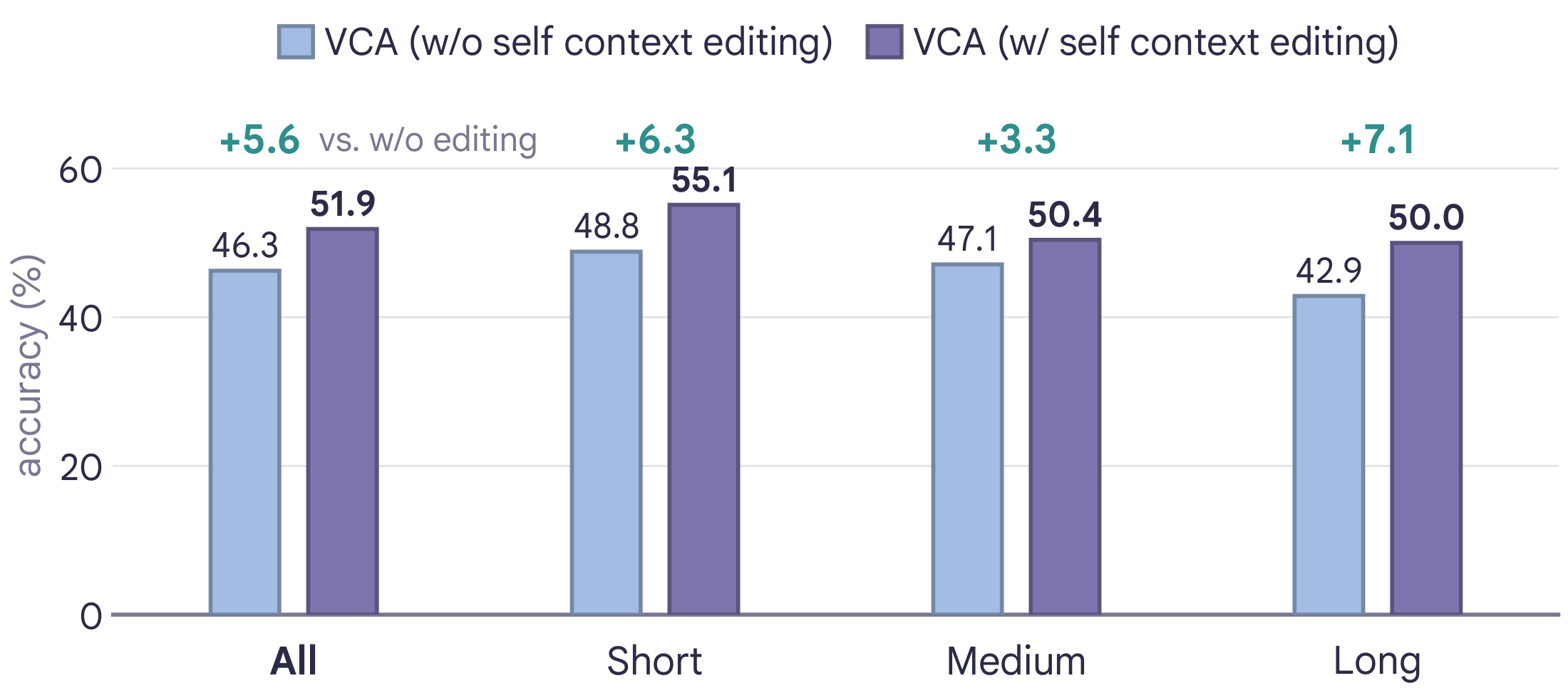
With backbone, tools and step budget fixed, we remove only the agent's ability to see frames first-hand and edit its own context. Accuracy drops by 5.6 points overall, and the gap grows to 7.1 points on the longest videos, where the agent has the most candidate clues to keep track of.
Example
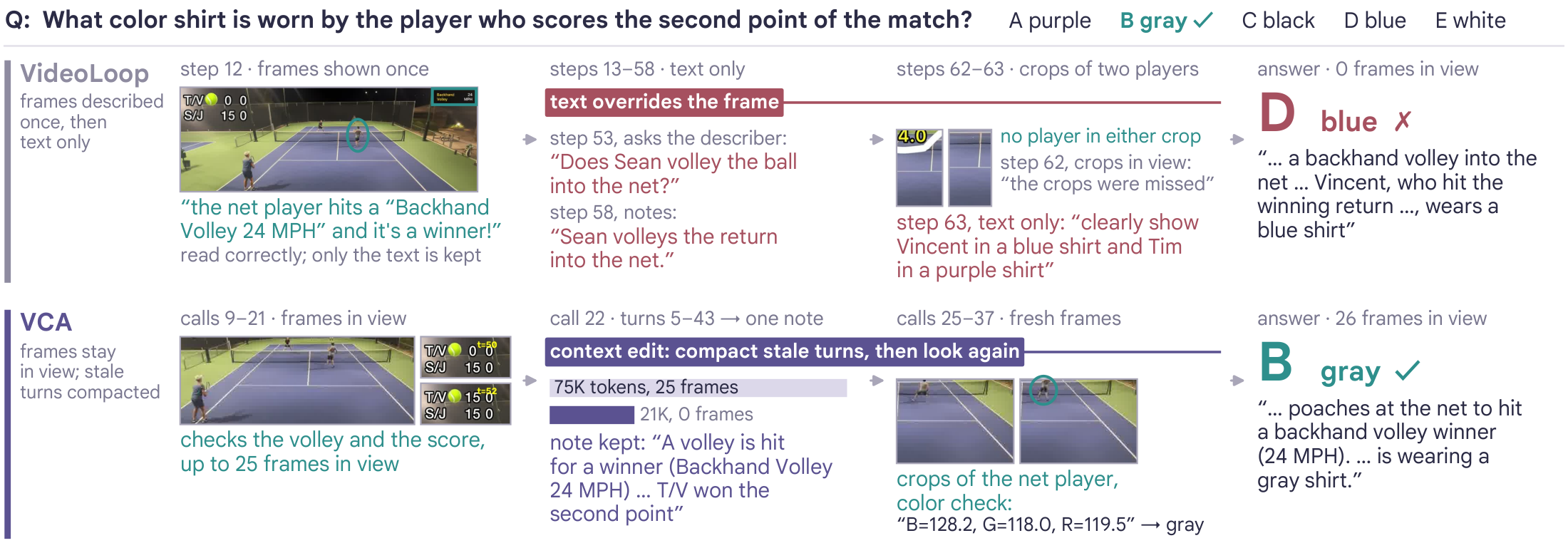
A fast-paced MINERVA sports question. VideoLoop (top) turns the rally into text early, and small ambiguities in its notes compound until a winning volley is rewritten as a net error. VCA (bottom) keeps the rally frames in view while it checks the scoreboard, compacts settled turns into verified facts, and looks at fresh crops before answering.
BibTeX
@article{luo2026vca,
  title={Visual Context as Action: Letting Video Agents Control What Stays in View},
  author={Luo, Mi and An, Joungbin and Dimakis, Alex and Grauman, Kristen},
  journal={arXiv preprint},
  year={2026}
}
 Visual Context as Action:
 1UT Austin
 2UC Berkeley
 3Bespoke Labs